

UN Replacement Migration: Engineering Demographics by Design
This is not a forecast. It’s a framework. It’s not speculation. It’s policy disguised as mathematics.

In 2001, the United Nations quietly published a 177-page report titled “Replacement Migration: Is It a Solution to Declining and Ageing Populations?” On the surface, it appears technical and neutral, a collection of charts, projections, and statistical jargon. But read closely, and the message is unmistakable: birth rates are collapsing, populations are ageing, and the UN’s proposed “solution” is the systematic replacement of shrinking native populations through sustained mass migration.
This is not a forecast. It’s a framework. It’s not speculation. It’s policy disguised as mathematics.
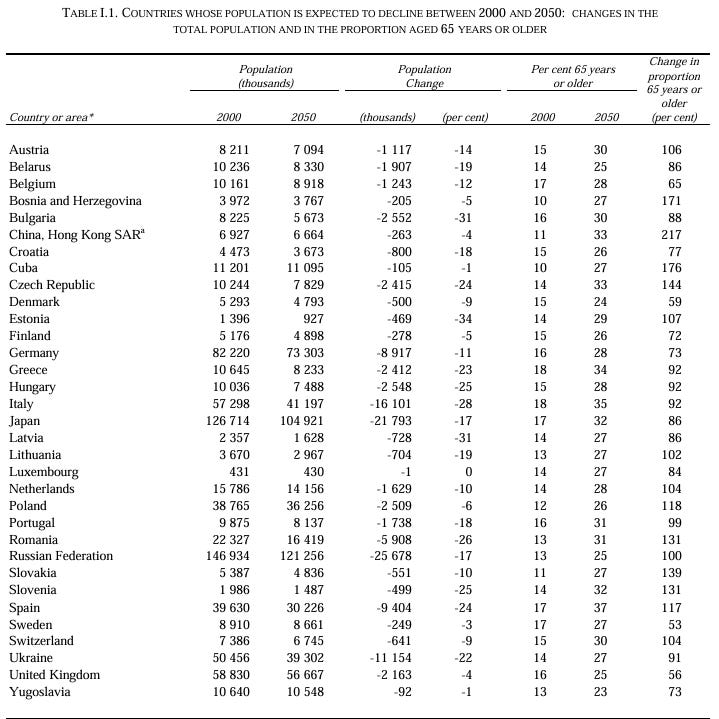
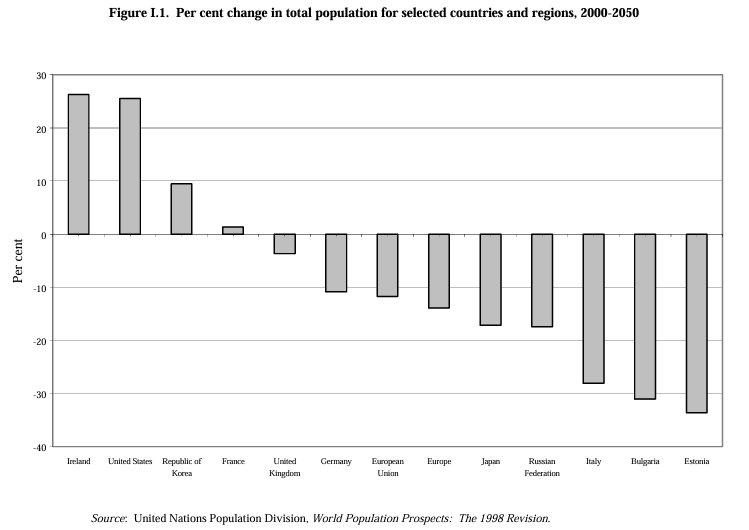
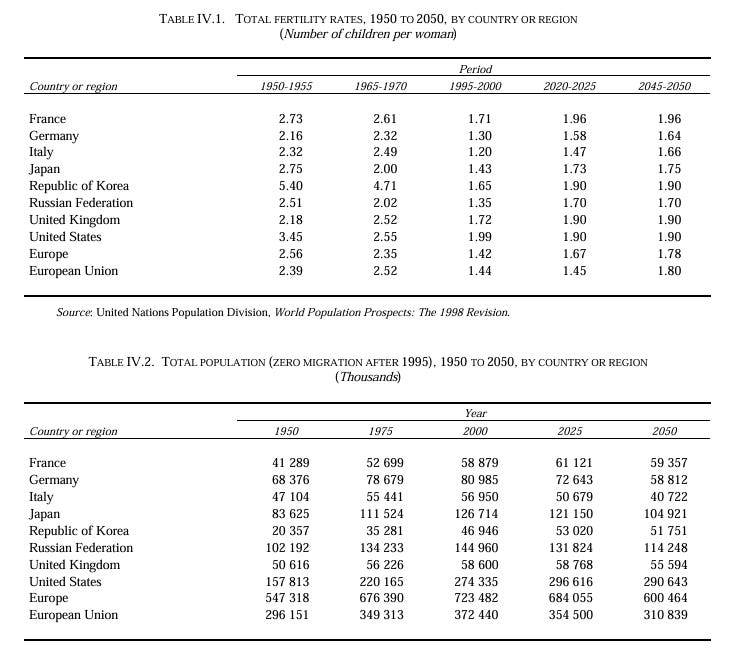
At the heart of the report is the claim that developed countries are headed toward demographic crisis: fewer workers, more retirees, and shrinking populations. Fertility rates have fallen off a cliff across Europe, North America, and East Asia. In 1950, France’s fertility rate was 2.7; today it’s around 1.7. Italy has plunged from 2.3 to 1.2, Germany from 2.4 to 1.3, Japan from 2.7 to 1.4, and South Korea from over 5.0 to under 1.7, and still falling. Europe overall has dropped from 2.6 children per woman to about 1.4. These numbers are far below the replacement level of 2.1 births per woman, and the UN assumes they will never recover.
Meanwhile, life expectancy has risen by a decade or more across most of the developed world. Populations are not just shrinking, they’re getting older at an unprecedented pace. The report focuses heavily on what it calls the potential support ratio (PSR): the number of working-age adults per retiree. Historically, there were 4 to 5 workers supporting each retiree. By 2050, across Europe, Japan, Korea, and Russia, that ratio will collapse to roughly 2 workers per retiree. In some countries, it will fall below 1.5.
That means fewer taxpayers supporting exploding healthcare costs, pensions, and welfare systems. It means slower economies, heavier tax burdens, and deepening intergenerational tension. The UN presents this as an existential problem, and then, without exploring alternatives, jumps directly to its preferred “solution”: replacement migration.
The report constructs five demographic scenarios. They are not presented as “policy,” but the framing leaves little doubt:
Scenario I assumes current trends continue.
Scenario II imagines zero migration after 1995.
Scenario III calculates the migration required to stabilize total population size.
Scenario IV calculates the migration required to stabilize the working-age population.
Scenario V calculates the migration required to maintain current worker-to-retiree ratios.

The numbers are staggering. Under Scenario III, to simply hold population size steady until 2050, Europe would need 100 million migrants, the EU alone 47 million, Japan 17 million, and Germany 18 million. Under Scenario IV, stabilizing the working-age population, the required numbers climb far higher: 161 million migrants for Europe, 80 million for the EU, 33 million for Japan, 25 million for Germany, 20 million for Italy, and 18 million for the U.S.
Scenario V is where the mask slips. To maintain current dependency ratios, roughly 4 working-age adults per retiree, the migration numbers explode beyond the realm of plausibility: 700 million migrants for the EU, 1.4 billion for Europe overall, 553 million for Japan, 593 million for the U.S., and an impossible 5 billion for South Korea. These figures aren’t accidental; they show the mathematical absurdity of solving ageing purely through migration, but rather than reject the framework, the UN uses it to normalize constant, high-volume immigration as policy.
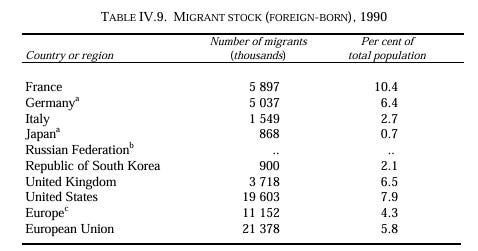
The demographic transformation implied by these scenarios is extraordinary. By 2050, under the UN’s own numbers:
Germany’s population would be 36% post-1995 migrants and descendants.
Italy: 39%.
France: 12%.
The UK: 14%.
EU overall: 26%.
Under Scenario V, these proportions jump dramatically, 80% in Germany, 79% in Italy, 68% in France, and 99% in South Korea.
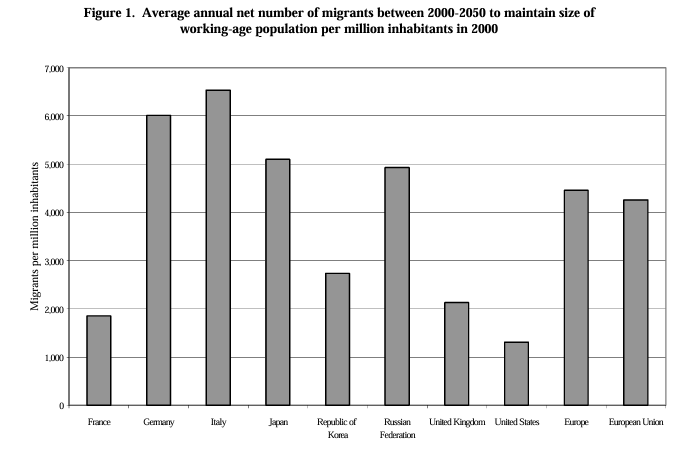
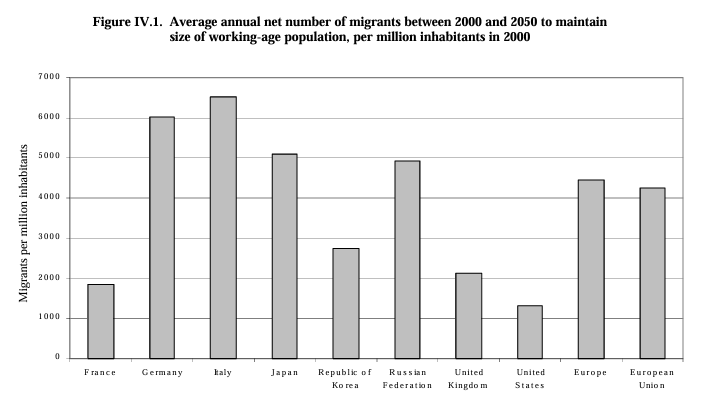
The report acknowledges these flows are historically unprecedented and politically explosive, yet frames them as “necessary.” Even for “moderate” stabilization, the EU would require 1.45 million migrants per year until 2050. Germany alone would need 6,000 migrants per million residents annually, Italy 6,500 per million, Japan 5,100 per million. These aren’t temporary surges. These are permanent, systemic inflows designed to fundamentally restructure populations within a single lifetime.
What the report doesn’t address is just as revealing as what it does. Nowhere does it seriously explore policies to reverse fertility decline: tax incentives for families, affordable housing, parental support, economic stability, or cultural renewal. It assumes families won’t recover, that citizens won’t have children, and that local populations are incapable of sustaining themselves.
Instead, people are treated like interchangeable economic units, variables to be swapped in and out to balance spreadsheets. There’s no consideration for cultural continuity, Indigenous sovereignty, or national identity. No discussion of whether societies have the capacity, economically, socially, or politically, to absorb sustained, transformative migration flows.
It’s not that migration doesn’t happen or shouldn’t happen; it always has. But the scale, speed, and framing are unprecedented. This isn’t about natural population movements, it’s about managing demographic composition at the global level.
The implications go far beyond economics. Once governments adopt this framework, demographic sovereignty effectively disappears. The choice is framed as binary: either accept rapid population replacement through migration, or face economic collapse as pension systems and welfare states implode. But there’s a third path the UN doesn’t model: rebuilding fertility, strengthening families, and reforming broken economic models.
Without that, nations face two unsustainable options:
Shrink, age, and accept falling living standards.
Import populations at scales that transform societies permanently.
The UN treats the second path as inevitable, and governments are increasingly aligning policies to match it. What’s presented as demographic inevitability is, in reality, a series of political decisions, decisions made without public debate, consent, or transparency.
By 2050, entire nations will have been reshaped, not accidentally, but by design. The report frames this as an economic necessity, but stripped of its technical language, the reality is clear: replacement migration is a strategy, not an outcome. It’s presented as the only “solution” because the UN assumes demographic decline is irreversible, and because it refuses to address the deeper causes of falling birth rates and economic fragility.
This isn’t conspiracy. It’s written plainly in their own data. The choice now isn’t whether populations change, they always have. The question is who controls the process: local communities, or global institutions treating people like variables in a model.
Darren Grimes
Much easier to control a country or society when no one is attached to the cultural norms and history of the place. A patchwork nation of differing allegiances to their fellow Canadians, and many fighting the battles of their homelands in Canada.
James Corbett did a good piece on Japan's depopulation - special phrase for it... Harakiri - demographic death, and so is everyone else: https://corbettreport.com/japan-is-committing-harakiri-but-so-is-everybody-else/
Very much a plan since 1799 when Pastor Thomas Malthus predicted the 'tipping point' for earth to sustain a population, thus depopulation is a must...
Little did they realize, creative possibilities not considered within the realm of possibilities were part of humanities success story in meeting supply and demand...
We could take a strong look at consumerism and pollution that follows!