

Technocracy Inc.
The Age of Invisible Power

Technocracy is often presented as progress - a sign that humanity has matured beyond tribalism, politics, and ideology. But stripped to its core, technocracy means rule by engineers, systems, and “experts,” where authority flows not from consent but from claimed competence. It is a governance structure where equations, algorithms, and technical expertise are treated as substitutes for collective decision-making, where political leaders gradually surrender control to specialists in the name of efficiency and precision. This shift didn’t happen overnight; it evolved alongside industrialization, automation, and the growing belief that society could be managed like a machine - predictable, measurable, and optimized.
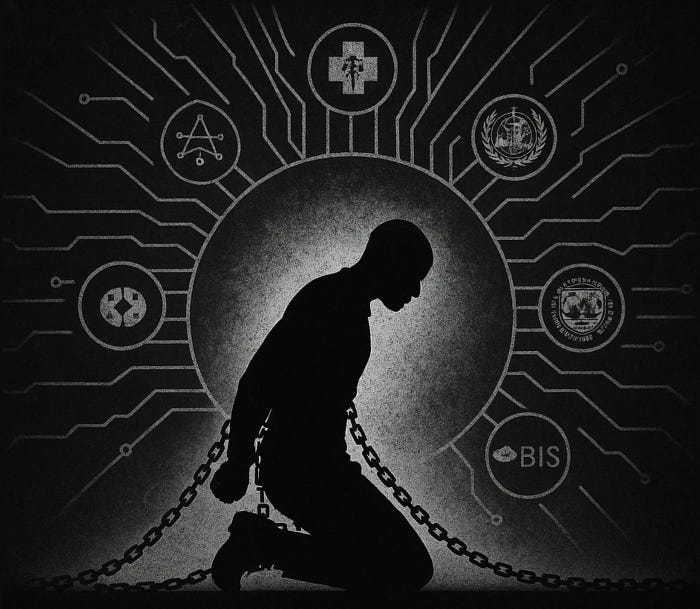
The roots of technocracy can be traced back to the early 20th century when engineering and systems theory collided with political thought. The industrial revolution had already proven that machines could replace human muscle; now the same philosophy was applied to human judgment itself. If production lines could be optimized, why not economies? If traffic systems could be modeled, why not entire cities? And if people were just another set of variables in a complex network, why shouldn’t they be governed like one? This was the seductive promise: eliminate the chaos of human politics, reduce uncertainty, and let the “best minds” run the world.
On the surface, this sounds logical - rational even. But logic has owners. Algorithms do not create themselves, and expertise does not exist in a vacuum. Every system reflects the priorities, values, and assumptions of the people who design it. When engineers are elevated to the role of policymakers, their worldview becomes the framework for everyone else’s reality. And when those frameworks are encoded into technology, the choices they make are largely invisible to the public. Decisions once debated in the open become buried in code, protocols, and statistical models that no ordinary citizen can challenge.
Technocracy thrives on this invisibility. It creates an architecture where control hides behind complexity. When a government claims “the model shows we must act,” it closes the door to debate. When an algorithm determines loan approvals, parole decisions, or vaccine mandates, accountability disappears into mathematical abstractions. Even when predictions fail - when the models are wrong, when the experts are mistaken - there is no recourse. The system adjusts itself, blames faulty data, and continues forward, unchallenged.
This also shifts the very definition of expertise. Under technocracy, power no longer belongs to those who represent the people but to those who control information. Scientists, engineers, and data analysts become de facto rulers - not through direct authority but through shaping the frameworks within which authority operates. Elected officials become figureheads reading from scripts written by specialists, their decisions justified by reports and projections few understand and fewer can refute. The appearance of democracy remains, but its substance quietly dissolves.
The most dangerous element is how technocracy manufactures consent. It doesn’t rule through brute force; it rules through the illusion of objectivity. When a politician makes a decision, you can question motives and ideology. When a system produces an answer, it’s presented as neutral and beyond dispute. “The data says” becomes a new form of divine authority. People stop arguing about whether a policy is right or wrong and start debating whether they’ve “interpreted the data correctly.” This shifts the battleground from ethics to metrics, reducing human values to technical parameters.
The deeper consequence is cultural. When society begins to equate intelligence with expertise and expertise with authority, individuality is diminished. People become users, not citizens - inputs rather than participants. Governance becomes less about human flourishing and more about systems management. A citizen’s role narrows to compliance within parameters they didn’t set and can’t meaningfully influence. In such an environment, personal freedom exists only to the extent it doesn’t interfere with optimization.
Technocracy is also inherently expansionist. Once established in one domain, it naturally seeks others. A system built to regulate energy consumption soon feeds into economic models predicting productivity, which in turn integrate with surveillance networks tracking individual behavior. Each layer justifies the next in the name of efficiency, security, or sustainability. Over time, governance becomes less about leadership and more about administration - steering a vast machine where no single individual appears to be in control, yet power concentrates silently in the hands of those who build and maintain the machine.
This quiet centralization produces a paradox: technocracy promises decentralization by claiming to distribute decision-making across systems and experts, but in practice, it funnels control upward. The more data a system collects, the more decisions are made at the top. The more predictive models influence policy, the less room there is for local context or human judgment. What looks like democratized access to information is often the opposite - it’s a narrowing of acceptable narratives enforced by the architecture of technology itself.
Technocracy also breeds fragility. Systems optimized for maximum efficiency are highly vulnerable to disruption. When everything is connected, when control flows through a few centralized channels, any failure - technical, economic, or political - cascades rapidly. In such an environment, resilience is sacrificed for precision, and the illusion of control masks the reality of systemic vulnerability. History shows repeatedly that over-engineered systems fail spectacularly, yet technocracy doubles down, convinced that better models, better data, and better tools will solve the problems created by its previous designs.
But perhaps the most insidious aspect of technocracy is cultural dependency. Over time, populations begin to internalize the belief that ordinary people cannot be trusted to make meaningful decisions. Agency is surrendered voluntarily because people are conditioned to defer to “those who know better.” Citizens stop expecting transparency, stop questioning authority, and eventually lose the vocabulary to articulate alternatives. Control no longer requires coercion; compliance becomes self-reinforcing because people genuinely believe there is no other way to manage complex societies.
By the mid-20th century, this mindset had already begun shaping the global order. Post-war reconstruction didn’t just rebuild cities and economies; it restructured governance itself around managerial expertise. New institutions emerged - financial, political, and scientific - that presented themselves as neutral arbiters of progress. But the foundational logic remained the same: rule by specialists, centralized control masked as collaboration, and authority justified by metrics and models rather than public consent. The world became a laboratory, and entire populations became experimental variables within it.
Technocracy isn’t the replacement of politics; it’s the perfection of politics under another name. It removes the messy, visible conflicts of ideology and replaces them with quiet, systemic decisions that shape the boundaries of what’s politically possible. It hides power where few people can see it and fewer can reach it. And once established, it rarely reverses itself - because the very systems that enable technocracy are the ones that define its legitimacy.
The Industrial Revolution reshaped civilization with a speed and violence unmatched in history. It created vast new wealth but concentrated that wealth into the hands of a small elite, transforming the balance of power across continents. Factories, railways, and mechanized production generated fortunes on a scale unimaginable a century earlier, but this economic transformation also created instability. The explosion of urban populations, the breakdown of traditional social structures, and the rise of a newly empowered working class terrified the ruling elite. What followed was a quiet counter-revolution - the birth of modern ideologies of social control designed to manage populations, channel dissent, and preserve concentrated power under the guise of progress.
The first wave of industrial capitalists saw clearly that mass production required mass compliance. Factories didn’t function if workers refused to show up, organize, or demand higher wages. The elite response was to engineer systems that could manage labor indirectly without relying on brute force. Education was redesigned not to liberate thought but to discipline it. Compulsory public schooling, introduced under the promise of literacy and opportunity, became a tool to train obedient workers who could follow instructions and accept hierarchy. The industrial model didn’t stop at machines; it extended to people. Human beings became another form of input to be standardized, optimized, and controlled.
Simultaneously, new ideologies emerged that reshaped how societies understood freedom, morality, and governance. Utilitarianism, born in the salons of the wealthy, reduced human value to productivity and output, framing the individual as secondary to the “greater good.” Eugenics followed, cloaked in scientific language, proposing that populations could be improved by managing reproduction and selecting traits deemed desirable by the elite. These ideas were not fringe; they were mainstream among industrial magnates, government planners, and academic institutions. The common thread was always the same: a belief that progress required management, and management required control.
The working class was not left out of this equation - it became its central focus. As industrial wealth expanded, so did the fear of revolt. Marxism and early socialist movements grew rapidly in response to brutal labor conditions, threatening to destabilize the very system that created industrial wealth. For the elite, the challenge became dual: suppress radical uprisings while co-opting reform movements to maintain legitimacy. Welfare programs, labor laws, and workplace reforms emerged not purely from compassion but as strategic concessions designed to prevent rebellion while preserving ownership and hierarchy. Social stability was manufactured, not earned.
Behind these ideological shifts came the rise of new institutions built to shape thought and behavior. Philanthropic foundations, often funded by industrial fortunes, played a central role. Organizations like the Rockefeller Foundation and the Carnegie Endowment presented themselves as altruistic forces advancing education, science, and public health. In reality, they were instruments of soft power, steering academic research, shaping curricula, and embedding elite values into the very framework of public life. By funding universities, scientific research, and media outlets, they exerted control over which ideas gained legitimacy and which were buried. The narrative of progress was carefully curated, and dissenting voices found themselves marginalized.
The Industrial Revolution also transformed government itself. States recognized that sustaining economic growth required predictability, and predictability required managing human behavior on a mass scale. Bureaucracies grew, census systems expanded, and surveillance began to evolve from a military function into a civilian one. Statistical modeling, population studies, and early social sciences became tools to predict and influence trends before they threatened stability. “Scientific management” - pioneered by thinkers like Frederick Winslow Taylor - turned workplaces into laboratories of efficiency, where every movement was measured, every decision optimized, and every deviation eliminated.
This fusion of wealth, governance, and ideology laid the groundwork for what followed in the 20th century: an era where the appearance of freedom masked increasingly subtle forms of control. Individuals were conditioned to believe they were free to choose while the range of acceptable choices narrowed. Public discourse was guided by experts and institutions whose authority came not from democratic mandate but from their claimed mastery of knowledge. The individual was reframed as a participant in systems they didn’t design, while collective identity was reshaped around productivity, conformity, and managed aspiration.
By the time the world entered the early 1900s, the foundation was set for the systems of control that dominate modern life. The same industrial fortunes that built factories and railroads also built schools, research institutions, media networks, and public policy frameworks designed to perpetuate their influence. Ideologies of social control weren’t imposed through overt tyranny but through normalization - the gradual integration of centralized authority into the routines of daily life. Control became cultural, embedded in habits, expectations, and institutional trust. People were conditioned to see their role not as sovereign individuals but as components of an economic engine, expected to work, consume, and obey.
The wealth generated by the Industrial Revolution didn’t just transform economies; it reshaped human psychology and societal structure. It created a managerial class whose power was defined not by birthright but by expertise, a class that believed it had the right - even the obligation - to design society according to its own ideals. From there, the leap to modern technocracy was inevitable. Once control could be justified in the name of efficiency, public health, or stability, the logic extended endlessly. The tools became more sophisticated, the data more precise, and the ideologies more subtle, but the underlying premise remained the same: power was safest when distributed upward, and populations were safest when guided, monitored, and managed.
This was not accidental or inevitable; it was deliberate design. The narrative of progress was written to obscure the transfer of agency from individuals to institutions. Industrial wealth built more than machines; it built systems - systems that trained generations to equate obedience with stability and dependence with security. What began as an economic transformation evolved into an architecture of control, one that survives today not through overt coercion but through shaping perception itself.
Democracy sells the story that power flows upward from the people, that consent forms the foundation of governance, and that leaders serve at the pleasure of those they represent. It promises a system where citizens shape laws, hold authority accountable, and steer the course of their collective future. But beneath this familiar ritual lies a different reality - one where unelected elites wield disproportionate influence, steering policy, shaping narratives, and deciding outcomes long before the public ever casts a vote. The illusion is sustained through ceremony and spectacle, but the substance of decision-making has been quietly removed from public hands.
The appearance of choice is central to this illusion. Citizens are presented with candidates preselected by party machines funded by corporate wealth, lobbied by powerful interests, and filtered through media narratives owned by the same few conglomerates. By the time the public enters the conversation, the boundaries of debate have already been drawn. Elections function less as moments of genuine decision and more as mechanisms of validation, ratifying paths already chosen by entrenched networks of power. Voters believe they are influencing outcomes, yet the machinery of policy - regulatory frameworks, economic strategies, and geopolitical positioning - operates largely outside democratic reach.
Unelected elites don’t announce themselves. They operate through institutions designed to appear neutral: central banks, intelligence agencies, trade bodies, think tanks, and international organizations. These entities set agendas, draft treaties, and manage crises with little transparency and virtually no direct accountability to the public. Decisions affecting billions - interest rates, financial bailouts, climate policy, military alliances - are made in boardrooms and closed-door summits, not parliaments or town halls. By the time such decisions reach elected officials, they are often framed as necessities rather than options, presented as technical matters beyond the understanding of ordinary citizens.
The media amplifies this divide, shaping perception rather than providing clarity. Narratives are curated, debates constrained, and public outrage carefully channeled into safe directions that leave core power structures untouched. The illusion of diversity in opinion masks the reality of a unified consensus among ruling classes on key economic and political priorities. Whether under conservative or progressive branding, the policies that sustain financial monopolies, perpetual debt, and globalized control remain largely unchallenged. Even when governments change hands, the deeper architecture of governance persists untouched, immune to electoral shifts.
This creates a form of managed participation where people are encouraged to engage just enough to validate the system but never enough to meaningfully disrupt it. Dissent is absorbed into controlled opposition, grassroots movements are co-opted or discredited, and radical alternatives are dismissed as unrealistic or dangerous. The public is conditioned to see complex governance as requiring specialized knowledge, reinforcing dependency on “experts” and “authorities” who are neither elected nor easily removed. Power consolidates upward while citizens are pacified with symbols - flags, anthems, campaigns, and slogans - designed to maintain emotional loyalty to institutions that no longer serve them.
This model thrives on invisibility. The real levers of influence - finance, intelligence, surveillance, technological infrastructure - operate beyond public scrutiny, embedded within bureaucracies that rarely change regardless of electoral outcomes. As the gap between perception and reality widens, trust in democratic systems erodes, but the alternatives are intentionally obscured. People are told that without these systems, chaos would reign, ensuring compliance through fear rather than genuine consent. In this way, democracy becomes less a mechanism of governance and more a performance - a story people are encouraged to believe while the true decisions are made elsewhere.
This erosion did not happen suddenly. It evolved alongside industrial capitalism, technocracy, and global integration, with each stage pushing more authority into the hands of those least accountable. Today, as automation, data-driven policy, and centralized financial systems deepen, the distance between voter and ruler has grown to the point where participation often feels symbolic rather than substantive. The paradox is sharp: citizens are freer than ever to express themselves, yet less able than ever to influence outcomes.
Democracy endures as a brand, a reassuring label attached to systems that no longer embody its original promise. The ceremonies continue, the campaigns grow louder, and the narratives more polarized, but behind the noise, the decisions that shape the future remain insulated from public reach. What emerges is not governance by the people, but governance through their consent to stories carefully designed to keep them in their place.
The framework of this book rests on a simple directive: follow the engineers, follow the money, follow the code. It’s not a slogan; it’s a map of power. Everything else - the institutions, the politics, the narratives - flows from these three converging forces. Where engineers design the systems, where money funds and directs them, and where code locks those decisions into permanence, you find the architecture of control shaping the modern world. This is not a conspiracy in the traditional sense; it’s a structural evolution. Power moves through infrastructure now - not speeches, not campaigns, but networks, protocols, and algorithms invisible to the public eye.
Following the engineers means understanding who builds the machinery of society, both physical and digital. The world runs on systems most people neither see nor comprehend - energy grids, logistics networks, communication satellites, data centers, and now artificial intelligence models that interpret and act upon reality at speeds humans can’t match. Engineers hold more influence than politicians because they design the rules inside which politics operates. A line of code can decide who gets a loan, whose posts are censored, or which supply chains collapse. Governments often implement policies constrained by what engineers deem possible, and yet these technologists are rarely accountable to voters or bound by democratic process. Their priorities - efficiency, optimization, and scalability - inevitably shape the limits of public freedom.
Following the money reveals the motives behind these systems. While engineers build, capital directs. Funding decides which technologies are developed, which remain experimental, and which are buried. Global finance prioritizes control, predictability, and returns on investment. If an innovation threatens entrenched interests or redistributes power downward, it is starved of capital and confined to obscurity. Conversely, technologies that centralize authority - surveillance tools, algorithmic management platforms, predictive analytics - receive nearly unlimited funding because they serve the interests of those who already hold influence. Corporations and financial institutions operate above borders, shaping national policies through lobbying, trade agreements, and debt structures, ensuring that control aligns with profit at every stage.
Following the code exposes how these priorities become permanent. Once decisions are embedded into software, protocols, and digital infrastructure, they are extraordinarily difficult to reverse. Code executes silently, enforcing policies automatically at scale. Algorithms make millions of decisions every second without oversight, interpreting human behavior through data and acting upon it without negotiation. Governance migrates from laws written on paper to rules embedded in systems, where consent becomes irrelevant because participation itself implies compliance. Opting out of these frameworks is nearly impossible - the modern individual relies on platforms and services designed not to be bypassed, where access to information, finance, and even identity depends on technological integration.
These three vectors - engineers, money, and code - converge into a new locus of power, one that is distributed enough to seem invisible but coordinated enough to dictate outcomes. Politicians debate symptoms while infrastructure shapes reality. Policy documents are drafted after the systems are already operational, long after the real choices have been made. Voters believe they are electing leaders, but the framework they live within has already been set by the engineers who designed the tools, the financiers who funded them, and the coders who wrote their logic into permanence.
The result is a quiet inversion of sovereignty. Where the industrial age was defined by control over labor and resources, the digital age is defined by control over information and access. The terrain of power is no longer land or factories but data, algorithms, and protocols. Whoever sets the parameters sets the boundaries of freedom, and those parameters are rarely debated in public forums. People are conditioned to see innovation as neutral and inevitable, yet every innovation encodes someone’s priorities, values, and worldview. The illusion of choice persists while the deeper architecture of decision-making hardens beneath it.
This framework is how we dismantle the illusion of randomness and chaos. By tracing the engineers, the financiers, and the code itself, patterns emerge - not abstract theories, but direct causal chains that show who benefits, who loses, and why. It reveals the subtle migration of power away from parliaments, courts, and town halls into systems most people do not control and cannot fully understand. It also exposes the continuity across eras: the same industrial wealth that birthed social control ideologies has now evolved into digital networks where governance is outsourced to algorithms and institutions insulated from public accountability.
To understand where we are, we must follow these threads relentlessly. The engineers are not neutral. The money is not benevolent. The code is not passive. Each carries intent, shaping the world silently while the public debates symbols. By studying how these forces intertwine, we reveal the deeper structure behind events that otherwise appear disconnected: economic crises, censorship battles, resource wars, and policy shifts that seem sudden but are anything but.
This is not about predicting the future; it’s about decoding the present. The levers of power no longer announce themselves. They operate through technical systems, private networks, and institutional consensus masked as objectivity. By following the engineers, following the money, and following the code, the architecture of control stops being invisible. Once seen clearly, it cannot be unseen.
That’s a good question!!!
Great explanation on Technocracy, thank you very well written. So what do we do to stop this Technocracy bull shit.